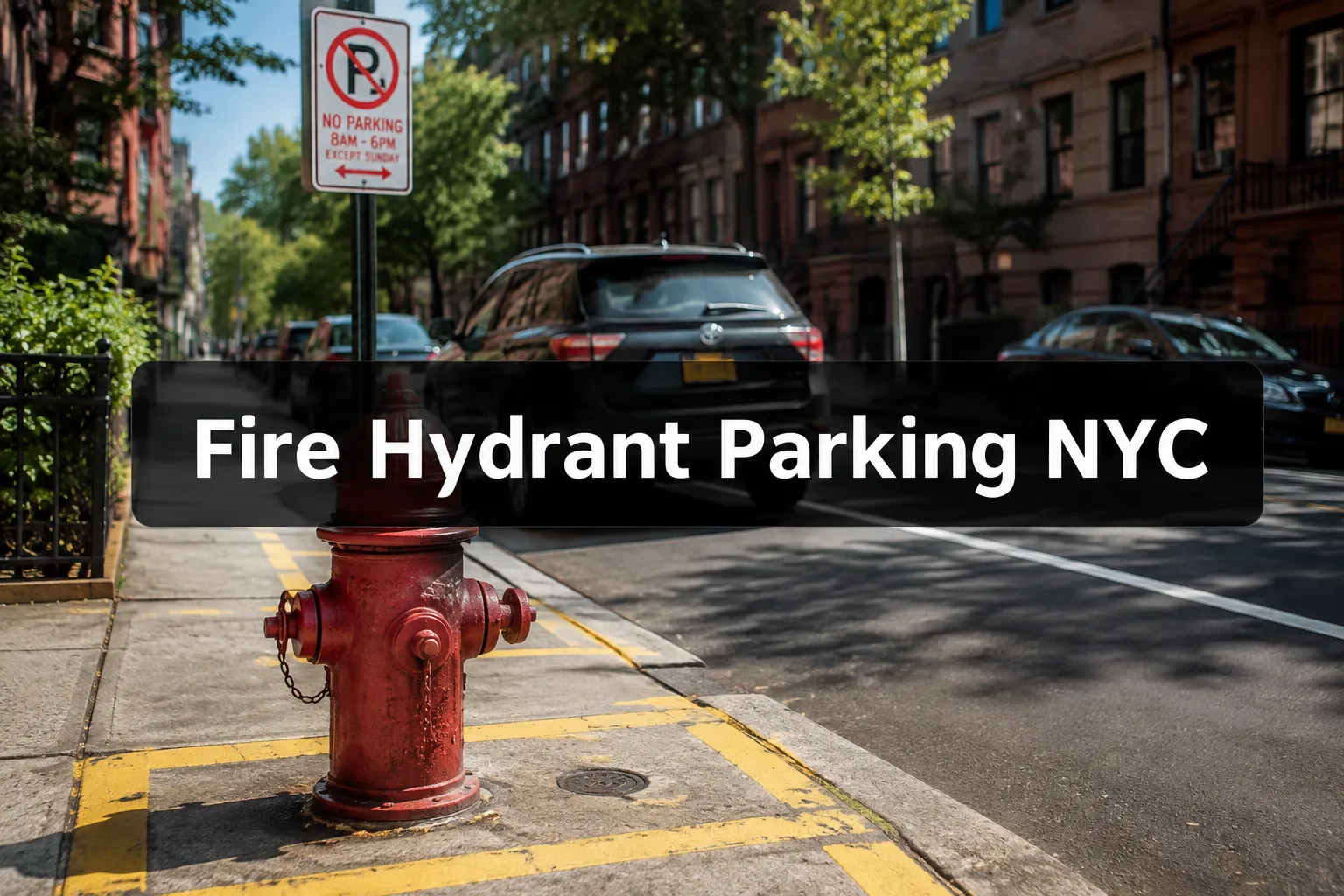
NYC issues over 10 million parking tickets annually, and fire hydrant violations rank among the most common, and most expensive, mistakes drivers make. Understanding exactly how close to a fire hydrant can you park NYC is not optional; it’s essential to avoid $115 fines and potential towing.
The official rule is absolute: 15 feet minimum distance from any fire hydrant, measured from the hydrant itself to the nearest part of your vehicle, on both sides of the hydrant, 24/7. This applies across all five boroughs and overrides painted curb markings, which are often faded or misleading.[1][2]
Key Takeaways
- NYC law prohibits parking within 15 feet of a fire hydrant on either side, before or after the hydrant, citywide, including floating parking lanes next to protected bike lanes.
- The 15-foot buffer equals approximately 4.6 meters, roughly one to one-and-a-half car lengths, or five to six walking paces.
- A limited daylight «standing» exception allows passenger cars to remain at a hydrant only if the driver stays in the operator’s seat, engine running, ready to move instantly, not true parking.
- Violation code 40 carries a standard fine of approximately $115 in 2026, and enforcement is strict regardless of curb paint condition.
- Measure distance from the hydrant center to your vehicle’s nearest point (typically front or rear bumper corner), not from painted curb lines.
Official NYC Fire Hydrant Parking Distance: The 15-Foot Rule
NYC Traffic Rules §4-08 establishes the legal standard: stopping, standing, or parking within fifteen feet of a fire hydrant is prohibited.[5] This distance applies to both the approach side and the departure side of the hydrant, drivers must leave at least 15 feet clear before the hydrant and at least 15 feet after it.[3][10]
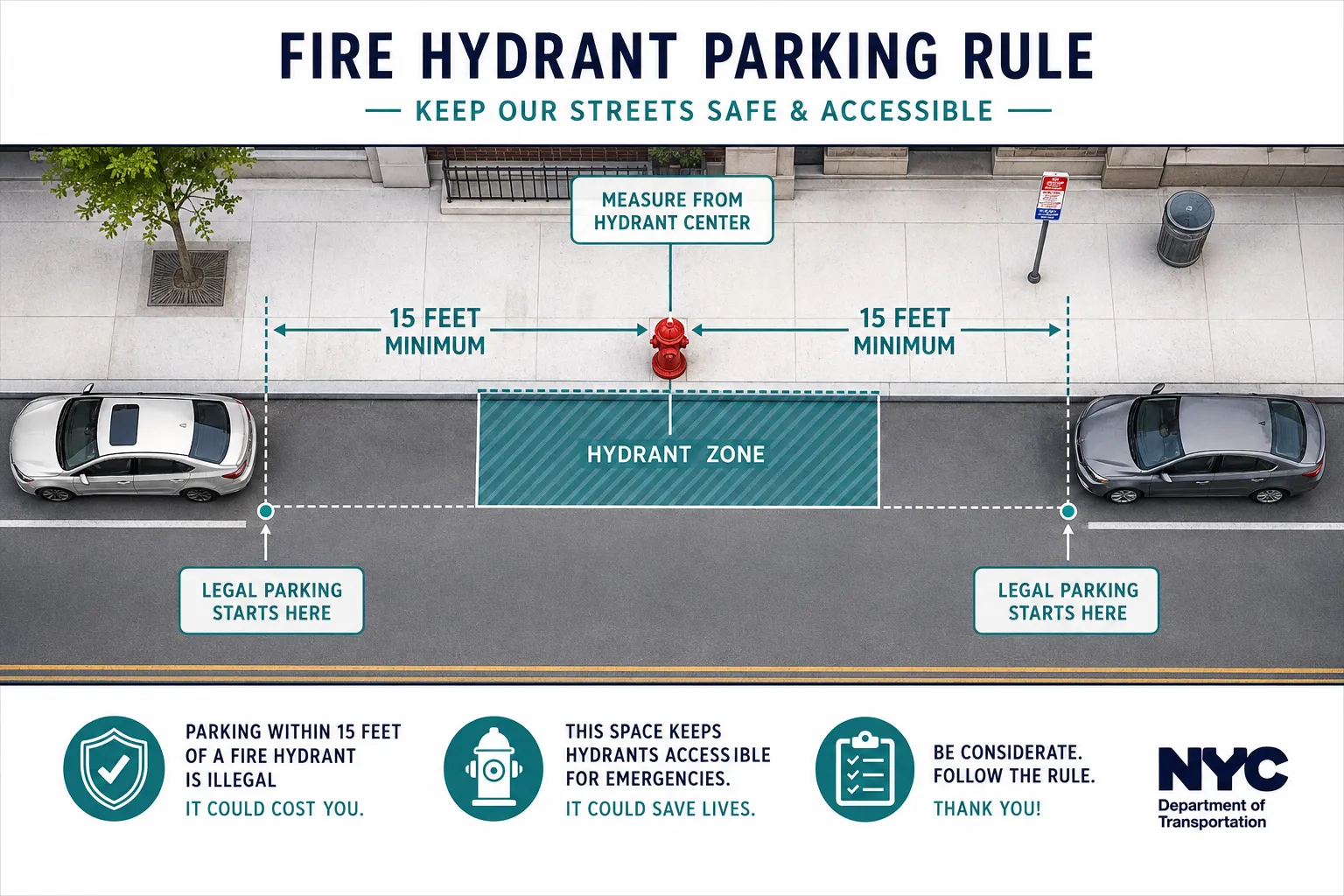
The NYC Department of Transportation’s 2026 parking regulations page, updated in late August, explicitly confirms the 15-foot rule remains in effect citywide, including newer street designs such as protected bike lanes with floating parking lanes.[2] The rule has been codified since at least January 2025 and has not been modified in subsequent updates through mid-2026.[5][2]
Measure from the hydrant itself, not curb paint. Many drivers mistakenly rely on yellow painted curb zones around hydrants to judge legal parking boundaries. Official guidance warns that painted curbs are not the legal standard, the 15-foot measurement always controls, even where paint is missing, faded, or inaccurate.[1][8] Calculate distance from the hydrant’s physical location to the closest part of your vehicle, typically the front or rear bumper corner.[8][7]
For quick street-level estimation, 15 feet equals roughly:
- 4.6 meters (metric)
- One to one-and-a-half car lengths (depending on vehicle size)
- Five to six normal walking paces (adult stride)[8][7]
The rule applies 24 hours a day, seven days a week, with only a narrow daylight exception discussed below.[6][3]
Understanding the Daylight Standing Exception (Not a Parking Permit)
NYC Traffic Rules §4-08 includes a specific exception that confuses many drivers: a passenger car may stand (not park) directly next to a fire hydrant during daylight hours, sunrise to sunset, under strict conditions.[5][6]
All four conditions must be met simultaneously:
- Standing is otherwise permitted at that location.
- The driver remains in the operator’s seat at all times.
- The engine is running and ready for immediate operation.
- The vehicle is moved instantly upon approach of fire apparatus or instruction from police, fire, or traffic officials.[5][3]
Practical enforcement guidance stresses this is not permission to park and leave your car, even briefly.[6][10][12] If you exit the vehicle, lock the doors, or walk away, even for 30 seconds, you are parked, not standing, and the 15-foot rule applies in full.[6][3] Ticket-defense experts report that many hydrant violations occur when drivers misinterpret this exception and step out «just for a minute» within the buffer zone.[10][12]
For practical purposes, treat the 15-foot rule as a strict no-parking zone 24/7. Any unattended vehicle within that buffer is subject to violation code 40, regardless of time of day.[6][12][3]
How to Measure 15 Feet Accurately on NYC Streets
Enforcement measures from the hydrant center to the nearest part of your vehicle,not to your tires, not to the car’s center, and not from painted lines.[8][7] The nearest point is usually the front bumper corner (when parking ahead of a hydrant) or the rear bumper corner (when parking behind a hydrant).[8]
Quick measurement methods:
- Walking paces: Take five to six normal adult strides from the hydrant to your bumper. If you reach your car in fewer than five paces, you’re too close.[8][7]
- Car-length rule: Leave at least one full car length (preferably one and a half) between the hydrant and your vehicle.[8]
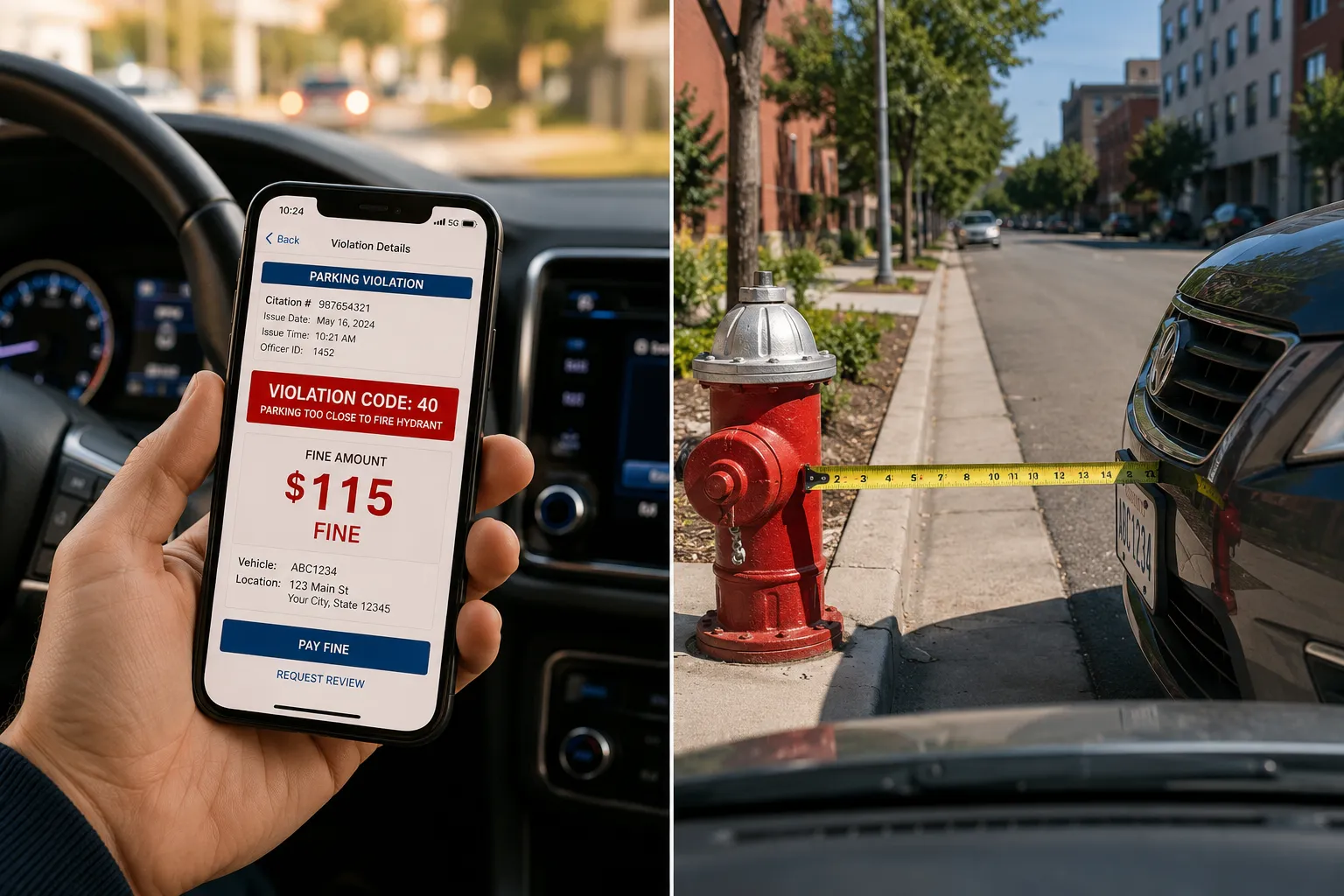
- Tape measure (most accurate): Carry a small measuring tape or use a smartphone app to confirm 15 feet (180 inches or 4.6 meters) before committing to a spot.[8][7]
Both sides matter equally. The 15-foot buffer extends in both directions along the curb. Drivers often assume the space immediately after a hydrant (in the direction of traffic) is safer or less enforced, it is not.[3][10] Enforcement applies symmetrically on both the approach and departure sides.[10][13]
When evaluating a curb space, also check for other distance restrictions that commonly overlap with hydrant zones:
- 20 feet from crosswalk areas (measured from the nearest edge of the crosswalk)
- 30 feet from stop signs or traffic signals on the approach side[11]
If a potential parking spot is near a hydrant and also close to a crosswalk or stop sign, you must satisfy all applicable distance rules simultaneously.[11]
Fire Hydrant Parking Violations: Fines, Enforcement, and Real-Time Status
Parking within 15 feet of a fire hydrant is classified as NYC parking violation code 40.[9][6] As of 2026, the standard fine for this violation is approximately $115.[9][12] Hydrant tickets are among the most common and rigorously enforced parking infractions citywide, with traffic enforcement agents and NYPD officers issuing them frequently.[9][12][6]
Why enforcement is strict: Firefighters require unobstructed access and clearance to connect hoses and operate equipment during emergencies. Even partial obstruction, such as parking close enough that hoses must be routed awkwardly, can delay response times, which is why the city maintains low tolerance for any vehicle in the hydrant zone.[3][14][6]
Check Real-Time Status and Suspension Calendars: While the 15-foot hydrant rule itself does not suspend for holidays or street cleaning, Alternate Side Parking regulations do. If you’re navigating complex parking rules in neighborhoods like Park Slope, Astoria, Williamsburg, DUMBO, or Greenpoint, use real-time suspension calendars to confirm whether Alternate Side Parking is in effect today. This helps you avoid layering a hydrant violation on top of an ASP ticket.
Unfair parking citations and disputes: If you believe you received a hydrant ticket in error, for example, if you have photographic evidence showing your vehicle was more than 15 feet away, consult resources on Tickets & Disputes for step-by-step guidance on contesting the citation. Document the scene with photos showing the hydrant, your vehicle position, and measurements before moving your car.
Towing & Impounds: Vehicles parked illegally at hydrants are subject to towing, especially in high-traffic or emergency-response corridors. If your car has been towed, visit Towing & Impounds resources immediately to locate your vehicle and understand recovery procedures.
Off-Street Parking Alternatives Across NYC Boroughs
When street parking near fire hydrants or in congested neighborhoods becomes too risky or time-consuming, off-street parking garages and lots offer predictable, legal alternatives. Explore the NYC Parking Directory to find facilities across all five boroughs, compare rates, and secure spots in advance.
Borough-specific garage options:
- Bronx: Quik Park, A&J Parking LLC, Easy Parking Lot, MAP Parking Garage, and dozens more listed in the Bronx parking directory.
- Brooklyn: Park Here Corporation, Stable Car Parking Incorporated, and additional options in the Brooklyn parking directory.
- Manhattan: J.B. Parking Lot, MPG: Manhattan Parking, 1568 Madison Ave Garage, and more in the Manhattan parking directory.
- Queens: 37-02 College Point Blvd Parking, Astoria Parking Management, Skyview Parking Lot, and neighborhood guides for Flushing and Astoria. See the full Queens parking directory.
- Staten Island: Huguenot Parking and other facilities in the Staten Island parking directory.
Parking Education Hub: For comprehensive guides on garage savings, rate comparisons, and strategies to reduce parking costs, visit the Parking Garages & Savings section of the Parking Education Hub.
Conclusion
Understanding how close to a fire hydrant can you park NYC is straightforward: 15 feet minimum, measured from the hydrant to your vehicle’s nearest point, on both sides, at all times. Do not rely on curb paint, do not assume the daylight exception applies if you leave the vehicle, and do not risk a $115 fine by guessing distances.
Actionable next steps:
- Measure accurately: Use walking paces (five to six strides) or a car-length estimate (one to one-and-a-half lengths) before committing to a curb spot.
- Check Real-Time Status: Confirm Alternate Side Parking suspensions and street cleaning schedules in your neighborhood to layer compliance across all parking rules.
- Explore Off-Street Options: When street parking is too uncertain, locate and compare garages via the NYC Parking Directory.
- Fight Unfair Citations: If you receive an incorrect hydrant ticket, document the scene and consult Tickets & Disputes resources immediately.
- Stay Informed: Bookmark suspension calendars and real-time alerts to avoid fines and towing across all NYC boroughs.
Avoid fines and towing by treating the 15-foot hydrant rule as non-negotiable. Locate your vehicle with confidence, check status in real time, and use the Parking Education Hub to navigate NYC’s complex parking landscape successfully in 2026.
References
[1] Article – https://portal.311.nyc.gov/article/?kanumber=KA-01026 [2] Parking Regulations – https://www.nyc.gov/html/dot/html/motorist/parking-regulations.shtml [3] Nyc Fire Hydrant Parking Distance – https://www.spotlink.app/nyc-fire-hydrant-parking-distance [5] 0 0 0 63770 – https://codelibrary.amlegal.com/codes/newyorkcity/latest/NYCrules/0-0-0-63770 [6] No Nonsense Guide To Nyc Fire Hydrant Rule – https://newyorkparkingticket.com/no-nonsense-guide-to-nyc-fire-hydrant-rule/ [7] In New York City How Far From A Fire Hydrant Can You Legally Park A Hire Car – https://holacarrentals.com/blogs/car-rental-united-states/in-new-york-city-how-far-from-a-fire-hydrant-can-you-legally-park-a-hire-car [8] How Close Can You Legally Park To A Fire Hydrant In New York And How Do You Measure It Quickly – https://holacarrentals.com/blogs/car-rental-united-states/how-close-can-you-legally-park-to-a-fire-hydrant-in-new-york-and-how-do-you-measure-it-quickly [9] Hydrant Parking Nyc – https://www.spotlink.app/hydrant-parking-nyc [10] Can You Park Near Fire Hydrant Nyc – https://www.spotlink.app/blog/can-you-park-near-fire-hydrant-nyc [12] No Nonsense Guide To Nyc Fire Hydrant Rule – https://newyorkparkingticket.com/no-nonsense-guide-to-nyc-fire-hydrant-rule/ [13] Can You Park Near Fire Hydrant Nyc – https://www.spotlink.app/blog/can-you-park-near-fire-hydrant-nyc [14] Nyc Fire Hydrant Parking Distance – https://www.spotlink.app/nyc-fire-hydrant-parking-distance